
30th and 31st May 2026: The National Stakeholders’ Consultation On Enhacing Access To Justice For Victims Of Domestic Violence in India
- teamdhwani
- Jun 10
- 4 min read

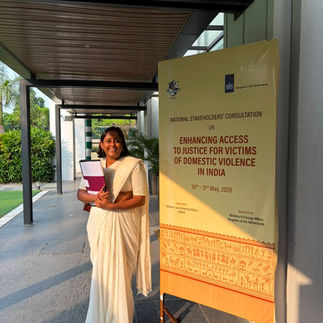

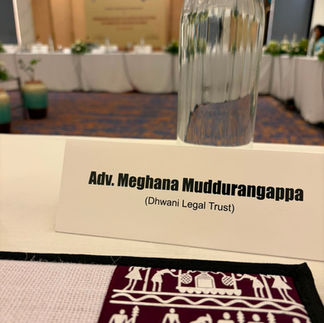

On 30th and 31st May 2026, Adv. Meghana Muddurangappa, Associate, Dhwani Legal Trust had the opportunity to be a part of the National Stakeholders’ Consultation on Enhancing Access to Justice for Victims of Domestic Violence in India organized by National Law University Odisha (NLUO), at The Crown, Bhuvaneshwar, this consultation was part of their project “Addressing Domestic Violence in Odisha through Institutionalized Domestic Violence Response Protocols”, supported by the Ministry of Foreign Affairs, Embassy of the Kingdom of the Netherlands. As a part of this project a study was conducted by the NLUO over a period of three years across thirty districts in the State of Odisha to understand the institutional barriers for various stakeholders and the working of the existing structures and the problems within them with regards to access to justice for victims of domestic violence.
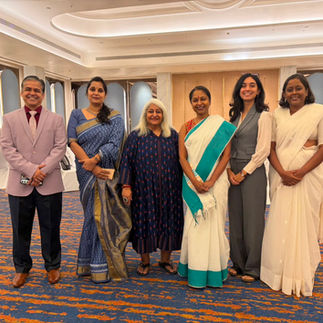
The delegation attending this consultation comprised of Academicians such as Prof. Dr. Saumya Uma, Jindal Global University; Prof. Dr. Sarasu Esther Thomas, Manipal Law School Bengaluru; Prof. Dr. Jyothi Dogra Sood, Faculty of Law, University of Delhi, etc; Mrs. S. Shyni, ADGP and CAW & CW, Odisha and other members of the Odisha Police; Presiding Officers across Courts in Odisha; Advocates and Lawyers from across the country; Members and Founders of Civil Society Organizations like Adv. Audery D’Mello from Majlis Legal Centre, Mumbai; Vibha Nadig from Outlawed India; Amla Shejwadkar from iProbono, Mumbai & Thane; Vandita Moraka from One Future Collective, and other like-minded people from similar background.
The consultation was spread over one and a half days and over six sessions. The first session of the consultation began with the organizers setting the context with a summary of their findings from their study and the field. Some of the points that were flagged, how a Domestic Violence victim is usually perceived as ‘Disgruntled Women’ or women who are not the same as other victims of crimes and violence. In the sense their idea of justice is not always simple and straightforward. For instance, while these women want help stop the violence, they are not always willing to send their husband or partners to jail. Further when the existing systems and infrastructures available were studied, it was found that there were only 1 One Stop Centers for one District across the State of Odisha making it inaccessible to many victims of Domestic Violence. Another pertinent point raised was that within the existing systems, heavy reliance is placed on counselling resulting in the victims being sent back to their perpetrators as well as victims of violence also relying on informal structures such as caste-based Panchayats or ‘Hulus’.
The second session focused on some of the prejudices, biases and stereotypes against victims of domestic violence. Further how victims are perceived by the Courts and few judgments of the Supreme Court were discussed to draw out instances of stereotypes referred to by the Courts. The third session’s theme was ‘Police Response to Victims of Domestic Violence: Experiments, Innovations and Possibilities in the Indian Context’. The discussion began with Mrs. S. Shyni Ma’am proposing various changes within the respect to the protocol within the State Police to equip them to handle and respond to cases of Domestic Violence. The theme for the fourth session five was “Proving DV Cases Beyond Reasonable Doubt: Obstacles in Appreciation of Evidence” where various decision of the Supreme Court was discussed to understand the standard of proof in Domestic Violence cases. A few lawyers also pointed out how under the PWDV Act, in the State of UP it is difficult for advocates to procure residence orders. However, this issue was not just limited to the State of UP, it seems to be the case in other parts of the country as well.
The fifth Session “Reviewing Institutional Structures for addressing DV: Challenges and Solutions”, some of the points that came across in this session was that Protection Officers being one of the first responders need more support and they should not have additional charges in order to ensure they can carry out their duties under the PWDV Act. It was also pointed out there was a lack of resources like vehicles to carry out rescue operations, protection, staff etc. which made it difficult for Protection Officers to carry out their duties. Further it was also pointed out that most of the States do not utilize the funds set up by the State and Central Governments like the Nirbhaya Fund intended to be used for the victims of violence. It was pointed out that Karnataka being one of the States which reported a high rate of Domestic Violence was also the State to underutilize the Nirbhaya Fund. It was also highlighted that NGOs and Civil Society Organizations should not merely function as service providers, but it is also important that they keep a check on the Government and its policies. Further urge the Government and its functionaries to implement the PWDV Act and other polices to make justice accessible to victims of violence. In the sixth and the last session, which was on ‘Community Engagement, Legal Aid and Resolution of Domestic Violence: Possible Pathways’, the discussion centered around what are some of the effective ways to create Legal Awareness and provide effective Legal Aid to victims of violence. How Legal Aid Clinics at Universities can be used effectively for Legal Awareness. It was suggested that just like Asha Workers, there should be women from the same community ‘Prerna Didis” to assist victims of violence to make law more accessible. It was also suggested that there should be self help groups from within the community.
It was a great learning experience in terms of understanding that some of the problems that we face as advocates in Karnataka while handling a Domestic Violence case are also some of the issues faced by others across the country. It was also interesting to understand some of the problems faced by Protection Officers and what are the difficulties they face while discharging their duties. In the last session while discussing Legal Awareness, Adv. Meghana Muddurangappa suggested that Legal Awareness must not be limited to ensuring that only the rights and remedies available under the law are disseminated, it is also important to explain and breakdown the legal process and the procedure laid down under the law. As legal process can be complex for non-lawyers to understand and navigate, so having information of this would help victims make a more informed decision or give them more clarity with respect to what they should be prepared for before initiating the formal process under the Law.


Comments