
11th December, 2025 : One day Session on Labour Laws for field staff of India Labour Line, Bengaluru.
- teamdhwani
- Jan 3
- 2 min read




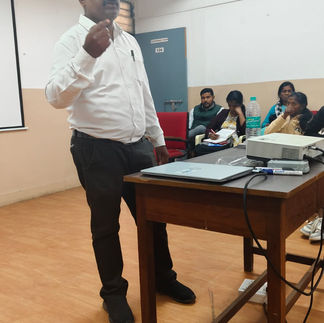

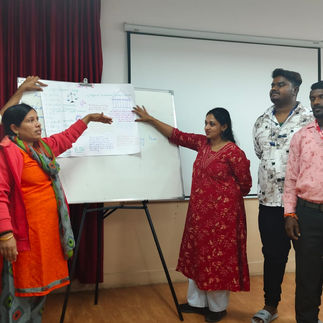

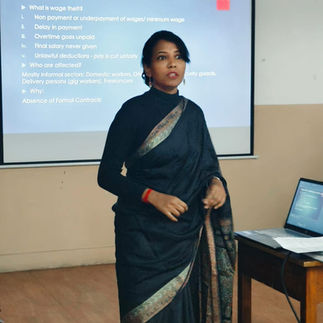



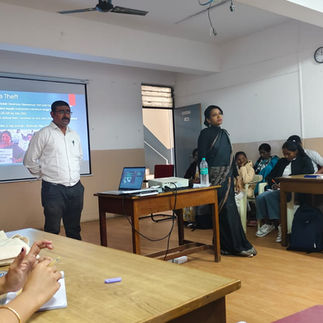
This one day session on Labour laws was organised by India Labour Line in collaboration with Dhwani Legal Trust on the 11th of December 2025 at Indian Social Institute, Bengaluru. The day commenced at 10:00 AM with an opening address emphasizing the power imbalance in the employer-employee relationship. The primary objective was to equip participants with the legal literacy required to identify violations and assist workers in the informal and unorganized sectors. There were around 35 participants.
The first half of the day focused on Wage Theft, defined as the non-payment or underpayment of wages for work performed. The Code on Wages, 2019, and its role in consolidating older acts was discussed in brief. Participants were taught to identify "hidden" theft, such as unpaid overtime and illegal deductions for "damage" to tools. The session ended with an activity where the participants were asked to share such cases they had handled. The opening session and the first session was handled by Adv. Archana Casmir
Following a short break, the discussion moved on to the Employees’ Compensation Act, 1923. The facilitator Adv Purushothama clarified that an employer is liable for any injury occurring "in the course of employment.” The participants were asked to calculate hypothetical compensation for permanent disability using the age-related "relevant factor."
The facilitator continued with the common myth that only "factory workers" get Provident Fund. Participants learned about UAN (Universal Account Number) portability and the worker's right to view their passbook. A checklist was created for common issues, such as UAN-Aadhaar mismatch and "missing contributions" by employers.
Post lunch, the session moved into the practicalities of the Labour Commission's role in Mediation and Conciliation. The Mediation Act, 2023, was analysed noting how it provides a more voluntary, confidential space compared to the formal, report-driven process of Conciliation under the Industrial Disputes Act, 1947. The session ended with an activity where the participants enacted a "Mock Mediation" where one participant played a injured employee and another an employer and few others as different characters. The "Conciliator" practiced the Do's (neutrality, active listening) and Don'ts (pressuring for a quick, unfair settlement).
The final session by Adv Archana focused on the key aspects of Documentation. Participants were introduced to the Case Diary format—a chronological log of events that serves as primary evidence in court. A Document list which served for gathering entire information of the Employers and Employees was designed and shared.
The day ended at 5pm with feedback from the participants and many expressed the need for a deeper understanding of the law and all of them were very happy with the methodology.


Comments