
7th February, 2026 : Public talk and discussion on Global Climate Justice And The Struggle Against Social Inequality by Akhil Mythri
- teamdhwani
- Feb 10
- 2 min read
Updated: May 20



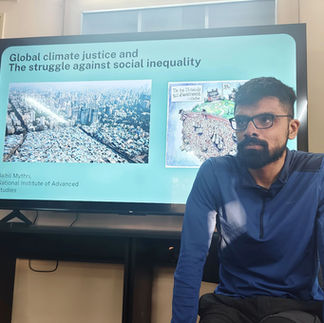

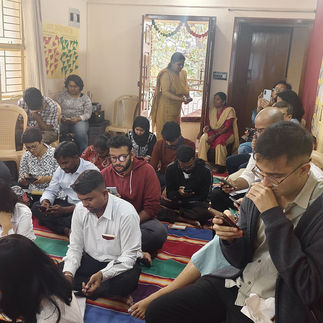




This event was organized by Dhwani Legal Trust. Around 30 people took part in the event. The talk was on Climate justice as an equitable distribution of the global carbon budget, directly linked to access to energy for most of the world’s population who are in the Global South. This view of climate justice challenges imperialism and links climate action with labour and land rights.
The talk was delivered by Akhil Mythri a multidisciplinary research scholar working on climate science and climate change policy. He is currently a doctoral candidate at the National Institute of Advanced Studies, Bangalore working on land use and climate change. He has contributed to critical analyses of climate mitigation scenarios from an equity lens, which have been presented at COPs and used by countries and civil society organizations of the Global South.
He opined that the intersection of climate change and social justice often called as Climate Justice reveals that the planet’s warming isn't just a scientific problem, but a deeply human one. Global Warming and Inequality is often described as the 'Double Injustice', those who contributed the least to global carbon emissions are usually the ones hit hardest by its effects.
Energy as a Tool for Social Emancipation: Dr. B.R. Ambedkar envisioned cheap and abundant electricity as a prerequisite for a just society. For marginalized communities, energy is the lever that moves the world away from hereditary occupations and toward industrial freedom.
Energy serves as the ultimate labor-saving device by removing drudgery. By replacing manual human labor with electrical power, we eliminate the physical "drudgery" that has historically defined the lives of the oppressed. Manual labor in many societies is coded by caste (sanitation, tanning) and gender (unpaid domestic work like fetching water or firewood). Electrification automates these tasks, breaking the material necessity of these roles and allowing for social mobility.
The speaker, Akhil emphasised on the fact on what one needs to understand what climate change actually is It is not merely local vehicular pollution, not plastic waste etc,. It is the cumulative effect of Greenhouse Gases (GHGs) like CO2 and CH4 trapping heat in the atmosphere over centuries.
He also went on to explain that The Carbon Budget is the finite amount of CO2 the world can emit while staying within safe temperature limits (e.g., 1.5°C). The central question of Social Justice is: Who gets to use the remaining slice of this pie? Wealthy nations achieved prosperity by exhausting the majority of the carbon budget. Expecting a developing nation to give up its share is not a solution when one person's luxury emissions (private jets/ACs) far outweigh another's survival emissions (cooking/basic lighting). Since the global North over-occupied the atmospheric space, they owe a debt, either in financial transfers or by vacating carbon space immediately to allow others to develop.
He believes that one cannot solve the climate crisis without solving the inequality crisis. Climate change is not distant to distributive justice but the very central part of it. The evening ended with thought provoking questions and an attempt to understand social injustice from a different prespective.


Comments